Fundamentals of HPT & Performance Improvement
WHAT IS HPT? Human Performance Technology (HPT) is about performance improvement and change management. HPT is a systematic process. It involves conducting a needs analysis, identifying the gap between present and desired performance; and then designing and developing an intervention that will manage the change process towards achieving this desired performance, all the while incorporating evaluation and feedback at every phase. HPT's systematic process as described by the International Society of Performance Improvement (ISPI) is the HPT model I was taught by Dr. Nadia Naffi at Concordia University's Educational Technology program. I describe the process below:
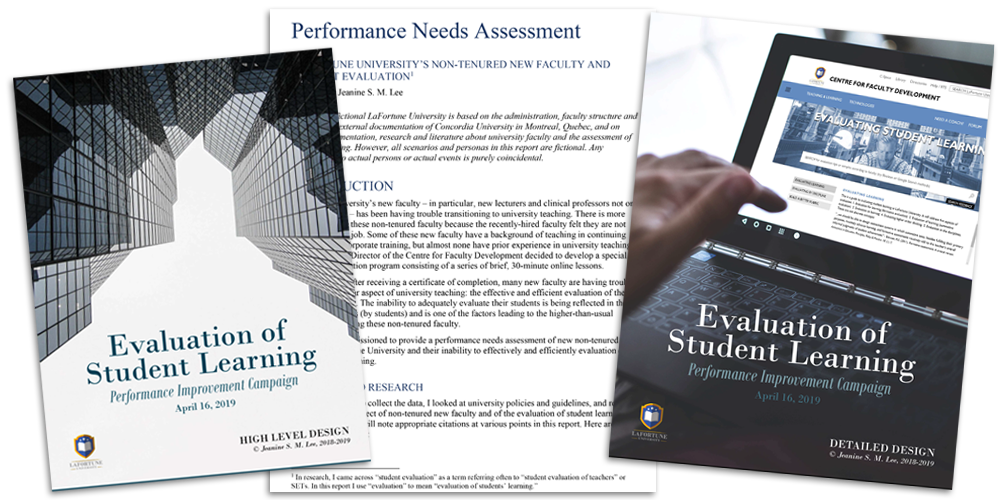
THE COURSE PROJECT: This is the performance improvement campaign I designed for my class in Human Performance Technology (ETEC 651) at Concordia in Winter 2019. The client was a fictional university called LaFortune University based on Concordia University in Montreal, Quebec. Research and analysis for this fictitious HPT case was based on Concordia's administration, faculty structure and documentation (only for academic purpose). All scenarios and personas in this report are fictional. Any resemblance to actual persons or actual events is purely coincidental.
THE CASE: LaFortune University’s new faculty – in particular, new lecturers and clinical professors not on the tenure track – had been having trouble transitioning to university teaching. The turnover among these non-tenured faculty was unusually high because these recently-hired faculty felt they were not prepared for the job, even after having taken a year-long orientation program on university teaching. In particular, many new non-tenured faculty were still having trouble with the effective and efficient evaluation of their students’ learning. The inability to adequately evaluate their students was being reflected in their course evaluations which had resulted in many in these lecturers leaving the university. The business objective in this situation, was to contain expenses incurred with high turnover of new non-tenured faculty.
Performance Needs Analysis (PNA)
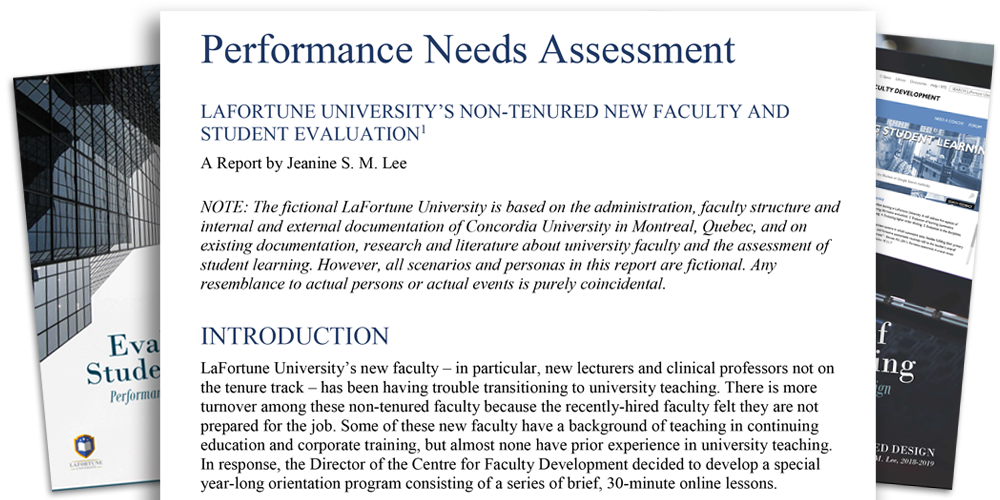
Conducting the Performance Needs Analysis is the first step in HPT. It involves identifying the gap between current and desired performance, as well as the possible underlying causes behind the problem. A needs analysis considers all aspects of the problem, from the individual to the organizational and contextual levels. I based my cause analysis on Chevalier's 2003 Updated Behaviour Engineering Model. This is not the right time to prescribe solutions, but rather research, interview and analyze possible bottlenecks impeding desired performance. The PNA document is presented to the client for approval, before any performance campaign is even discussed. It is essential that the root causes of the performance problem are first identified, and then reported to the client.
- Skills acquired: Honed research abilities and "investigative skills"; writing objectives; understanding of Behaviour Engineering Models (Chevalier's updated BEM; Gilbert's BEM); creating personas
REFLECTION: Writing the PNA was like playing detective. Chevalier's Updated BEM was very helpful in giving me clues in what I was trying to uncover, whether it was from the individual performer's level or the organizational, environmental level. I began understanding the layers of complexity that underlies some human behaviour. And, yes, it was tremendously tempting to jump to conclusions and think of interventions right away. I resisted! We were unable to interview new non-faculty members at Concordia University because the scope of our class only gave us so much time and resources. All the research had to rely on existing documentation, and existing university infrastructures.
I used my prior work experience as a newsroom designer and training as a journalist. Finding sources and researching background information came in very handy. I could concentrate my efforts on learning what HPT meant and how to conduct a PNA. While I had been introducted to Needs Analysis at an Instructional Design course last term, I found it was only during this HPT class that I began to understand and appreciate what an Analysis meant in both an HPT and ID context.
High Level Design (HLD)

Creating the High Level Design (HLD) is the next step for an HPT consultant in the design and development of a performance improvement campaign. In this case, it involved presenting all the main interventions necessary to improve the performance of new non-tenured faculty, in effectively and efficiently evaluating student learning. Based on the conclusions of the PNA, these interventions would clear those identified bottleneck issues and eliminate the gap between current and desired performance. In this HLD, I presented four interventions targeting non-tenured new faculty as the main users (previously known as performers in the PNA): two interventions targeting staff at the Centre for Faculty Development, and two more targeting Teaching Assistants at the university.
REFLECTION: Writing the HLD was rather fun! While I was constrained by the context and case, the actual interventions could be whatever I could think of that would affect change on an individual level, taking into account groups of users or even organizational infrastructure that could also be affected by said interventions. Having these constraints actually helped shape the interventions. Based on my PNA conclusions, I knew non-tenured lecturers were rarely given university equipment for personal use - like laptops or phones. I knew they were likely to be contractual term hires, so they probably did not have a strong supporting network of peers at the university. And I could not find many resources at the Centre for Faculty Development for student evaluations. This is why I thought the best interventions should include a responsive website as well as peer and faculty support. The HLD is an overview of a campaign that could affect multiple groups of users in a university. One intervention could necessitate sub-interventions addressing other user groups. While I enjoyed the process of thinking out the complexities of designing effective interventions, I could see how it could easily spiral into a mess!
- Skills acquired: High Level Design Thinking! Designing user-centric interventions based on objectives developed in the PNA
- Software used: Adobe InDesign, Photoshop & Illustrator (creating graphics, photo editing and designing the document)
For the actual design of the HLD, I relied on my prior work experience as a newsroom designer. I used Adobe InDesign to lay out the document, and Adobe Photoshop for photo editing. Knowing the Adobe product line came in handy. Because of this, I could rework the document a few times while modifying details of the interventions. This was to be an ongoing situation. I discovered that much of HPT is like a running towards a moving target - flexibility is key on so many levels: discovering, designing and developing the case, handling client expectations (I'm anticipating), and working through basic project management.
Detailed Design (DD)

Developing the Detailed Design (DD) is the next step in designing and developing the performance improvement campaign. In this document, we choose our main intervention that will guide the targeted users towards desired performance. For my clients at LaFortune University, I chose to redesign an existing website with an enhanced intranet search function.
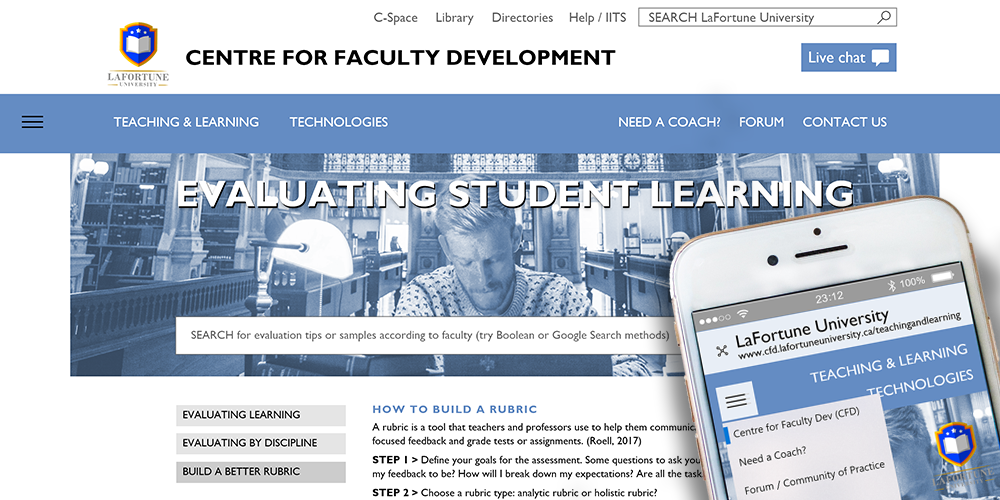
I felt a redesigned website (see prototype above) was the best intervention that could readily address four of the eight interventions I described in my HLD. It would feature two primary sub-interventions, namely, the Intranet Search Function and the Build a Better Rubric Job Aid. And it would contain two other sub-interventions addressing faculty and peer support: The Need a Coach sub-intervention matches new non-tenured faculty with peer faculty so they had someone to review their assessment strategies and to mentor them through their first year of teaching. A Forum / C.o.P. sub-intervention lists available and active forums in which these faculty members could participate in a community of practice.
THE PITCH: During our DD workshops, we had to pitch our campaign or create a 5-minute trailer. Since all redesigned websites have to seek the approval of University Communications Services (UCS) at Concordia University (which the fictional LaFortune University is based upon), I chose to present to the UCS in class.